Monday, September 12, 2011

Screen shot 2011-08-30 at 3.08.15 PM.png Meet the Butcher: Jason Fox

JasonFox.jpg
Photo by Lindsay Pugnali

Jason Fox will be the manager of the new Fleisher's shop in Park Slope, Brooklyn. He recently sat down with the Butcher's Case to talk about the new shop, his background in the food world, and his pick for the most underrated cut of meat.

The Butcher's Case: How did you decide to become a butcher?

Jason Fox: I have a history of working in the food industry. I worked in my grandfather's deli when I was growing up, and I was a food photographer and food stylist for several years. And the more I worked with food, the more I realized I wanted to open my own restaurant in Brooklyn. I wanted it to be nose-to-tail and seasonal, and I wanted to do my own butchering. I knew about Fleisher's, so last winter I took their eight-week butchery course and apprenticeship.

During that time, the restaurant plans fell through. I was talking to Josh [Applestone, Fleisher's co-owner] about it, and he said they were planning to open a shop in Park Slope, and he asked if I wanted to run it. I couldn't refuse an opportunity like that.

TBC: So when did you really know that you'd made the leap and you were doing what you were meant to do?

JF: I was driving home from Fleisher’s after cutting all day, literally still covered in blood, and instead of being disgusted I realized I really loved the smell.

TBC: You're going to be running the Brooklyn shop—which makes sense, because you already live in Brooklyn, right?

JF: Yes, I live in Bushwick. I’ve been commuting back and forth to Kingston, but after a long day of hauling and cutting meat, carrying rounds and arm chucks, you want to be in your own home. My boyfriend is in Brooklyn, my dogs are in Brooklyn, so it's worth the long trip back home. So, I'm looking forward to the commute from Bushwick to Park Slope. It should be much better!

TBC: It seems that everyone at Fleisher’s has a specialty. Some people focus on charcuterie or creating sausage recipes. What is your forté?

JF: People in the Slope tend to be very busy, so I've been working a lot in the kitchen with various cuts of meat to come up with new additions for our line of prepared foods. Cottage pie, meat loaf, meatballs, a sausage pie. The sausage pie was my biggest challenge, but I was able to marry the two textures (sausage and flaky pie crust) by creating a mustard béchamel. It’s delicious, and a recipe I’m really proud of, but there are going to many options to choose from.

TBC: Everyone on the Fleisher’s staff seems to have been a vegetarian at one time or another, too. What about you?

JF: I was a vegetarian for 16 years, but I really felt like I was missing out after awhile. I was doing a lot of cooking for other people and it was often meat-based, so I started to feel left out. I felt like I couldn’t be a good cook if I didn’t start to eat meat.

TBC: Let's talk a bit about the Brooklyn shop. If someone walks in, will they see you cutting meat, just like in the Kingston shop?

JF: Yes, that's the Fleisher's way, to work out in the open. You'll see us cutting every day for the case.

TBC: The Kingston shop is only open on Thursday, Friday, and Saturday. What about the Brooklyn shop?

JF: We'll be open every day except Monday.

TBC: Okay, lightning round questions: What's your favorite steak to eat?

JF: You can't beat a rib-eye. One rib-eye, an inch and a half thick, will feed two people. Personally, I like it very rare.

TBC: What's the most underrated or overlooked cut of meat?

JF: People tend to be scared of oxtails. But they're very affordable, they have a really beefy flavor, and they're easy to cook, because you just put them in the oven and braise them. If people would try them, I think they'd be surprised how good they are, and how simple they are to prepare.

TBC: Favorite ingredient?

JF: Stock, I use it in everything. We sell every kind at Fleisher’s—from lamb to duck.

TBC: Meal that you would make for your boyfriend after a fight?

JF: Lamb anything, potato anything—he’s Irish.

TBC: Favorite side dish?

JF: Roasted Brussels sprouts with Fleisher's bacon, made crispy in a cast-iron skillet. We are even growing Brussels sprouts in our garden, I love them so much.

TBC: Favorite type of customer?

JF: Little old ladies. They always know exactly what they want!

TBC: Favorite technique that you have learned at Fleisher’s?

JF: I didn’t know anything about the Jaccard meat tenderizer. It really does the trick for notoriously chewy steaks like London broils and flatirons. It has 48 flat blades, like little needles, that puncture the flesh and shorten the muscle fibers. It’s really eye-opening.

TBC: Anything to add?

JF: Just that I'm really excited about the new shop. We're going to have a really good time. We love what we do, and the mood in the shop will be very happy, very positive. I think people will notice it right away.

The Brooklyn branch of Fleisher's is scheduled to open on Sept. 22, at 192 Fifth Avenue, between Sackett and Union Streets.

Friday, September 9, 2011

Screen shot 2011-08-30 at 3.08.15 PM.pngThe Butchery Archives, Vol. 2

irish butcher shop, 1901.jpg
Click on photo for larger version

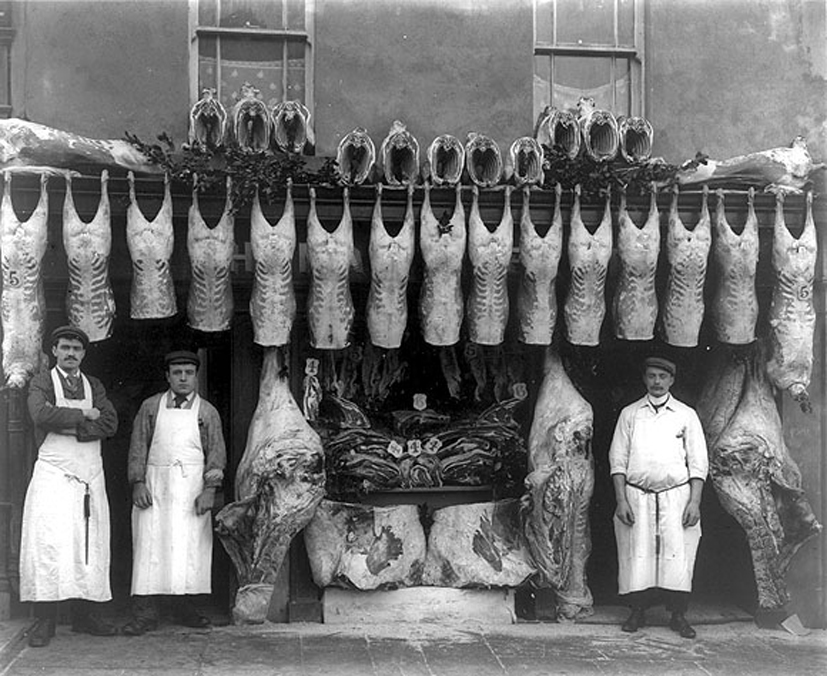
Here's the latest in our Friday series of old butcher shop photos. This one shows an Irish meat market, circa 1901. Look how everything is arranged in perfect symmetry -- except the butchers themselves.

We'll have more vintage butchery photos and ephemera each Friday. If you have any material you'd like to contribute, send it here.

Thursday, September 8, 2011

Screen shot 2011-08-30 at 3.08.15 PM.png Aging: Wet vs. Dry

Dry-Aged Beef 4
Photo by Flickr user Gary Grogan
By Paul Lukas

One question people often ask about Fleisher's beef -- and about beef in general -- is, "Is it aged?"

Much like beef grading, which we discussed last week, aging is a term that tends to intrigue people, even if they don't fully understand what it means. We'll provide a basic explanation of it here.

First, it's important to understand that beef can actually be too fresh. You wouldn't want to eat beef the same day it had been slaughtered. It would be, quite literally, a bloody mess. It would also be extremely tough (the carcass must pass through the rigor mortis stage).

So all beef is aged to some degree. Most of it is wet-aged, which means it has been sealed in a Cryovac bag -- usually for a week or two, sometimes longer. This helps break down the meat's connective tissue, making it more tender, although it does nothing much for the meat's flavor. Meanwhile, some of the blood drains from the meat, so the beef is literally sitting in a pool of its own bodily fluids. This liquid is called purge, because it will be discarded when the Cryovac bag is eventually opened. This is how virtually all supermarket beef is processed, and most conventional restaurant beef as well.

Then there's dry-aging, which involves storing the meat under precise climate-controlled conditions. The aging chamber can be as large as a sizable room or as small as a wall-mounted refrigerator case, but the key is that the meat is maintained under precise climate-controlled conditions -- low temperature, relatively high humidity, and fans to provide lots of air circulation. Much like wet-aging, dry-aging provides time for the meat's connective tissue to break down and tenderize. In addition, the exterior of the meat becomes covered with a light coating of mold and forms a tough, dark outer crust that will eventually be cut away (some packing or processing houses call this the scab).
dry aged perfection
Photo by Flickr user DeBragga

Inside, however, some of the beef's moisture is evaporating, which concentrates the meat's flavor in a way that people have variously described as earthy, musky, mineral-y, funky, or just beefy. It's a much more complex flavor than what you get with wet-aging -- all the more so if you start with the pastured beef Fleisher's sells, because pastured beef is always more flavorful to start with.

Our beef carcasses typically hang for a week at our slaughterhouse before being broken down into the primal sections -- the chuck, the rib, the loin, and the round -- from which we will eventually cut steaks, roasts, and so on. Then the primals are dry-aged at our shop for up to four weeks, depending on the cut. Our rib-eyes, New York strips, and sirloins get the longest time in our coolers, and both the taste and the price reflect their extended stay.

Dry-aging is expensive, because there can be significant loss of product during the aging process. Between the evaporation and the cutting away of the outer crust, beef can lose up to 25% of its weight by the time it's done aging and ready to sell. But once you taste one of our dry-aged steaks, you'll know it's worth it.

Tuesday, September 6, 2011

Screen shot 2011-08-30 at 3.08.15 PM.pngAh, There’s the Rub

IMG_0002.jpg
Photo by Jennifer May

From time to time the Butcher's Case will be featuring recipes from The Butcher's Guide to Well-Raised Meat, written by Fleisher's co-owners Joshua and Jessica Applestone. Today I want to start with a recipe that's versatile enough to appeal to virtually everyone reading this, no matter what kind of meat you like best: Fleisher's dry rub.

Although this rub is best known as the secret behind Fleisher's popular rotisserie chickens, it can also be applied to steaks, spareribs, roasts, or even seafood. Seriously, it pairs well with just about any protein, thanks in large part to the way the spicy paprika is offset by the herbaceous sage. Here's the recipe:
1/2 cup coarse salt
1/2 cup dried sage
1/3 cup garlic powder
1/4 cup onion flakes
1/4 cup paprika
3 tablespoons dried thyme
3 tablespoons freshly ground black pepper
3 tablespoons dried oregano
1 tablespoon cayenne pepper

Combine all ingredients in a large bowl, rubbing the sage, thyme, and oregano between your palms to crush them as you add them to the mixture. The mix will keep in an airtight container for up to six months. Shake or mix well before applying to chicken, beef, pork, or seafood. Makes 2 cups.
If you've never tried dry rubs before, give it a try. No matter what you like to cook, you'll find it packs more of a punch when you treat it with this rub.

Screen shot 2011-09-05 at 8.02.58 PM.png

Hamburger Helper: It's been a mixed bag lately for the Butcher's Case's favorite ballplayer, Texas Rangers pitcher Mark Hamburger. After pitching a perfect 1-2-3 inning in his big league debut last Wednesday, he lost his baseball virginity two nights later, getting roughed up for three runs in two innings. But then he recovered on Labor Day, tossing a scoreless inning. You can keep track of his game-by-game progress here.

Monday, September 5, 2011

Screen shot 2011-08-30 at 3.08.15 PM.png Words to Live By

eat-meat_640.gif
Photo and animation by Kirsten Hively, Project Neon

As the nation fires up its grills and smokers this Labor Day, the Butcher's Case hopes you'll find inspiration in the sign shown above. We like to think of it as a neon mantra.

Everyone have a great holiday. We'll have lots of full-length posts later this week.

Friday, September 2, 2011

Screen shot 2011-08-30 at 3.08.15 PM.pngThe Butchery Archives, Vol. 1

william cohen butcher shop.jpg
Click on photo for larger version

We love old butcher shop photos. They tend to evoke the same sense of community and pride in one's craft that we strive for at Fleisher's (not to mention that the meat in the old photos was mostly grass-fed and all hormone- and antibiotic-free). This one, showing an old butcher named William Cohen, was submitted by one of our Kingston customers, who's one of William Cohen's descendants.

We'll be running more of these old photographs in the weeks to come. If you have some you'd like to share — regardless of whether you're related to the butcher in the photo — send them in. Or just bring them over to Fleisher's. It'll make our day.

Have a great Labor Day, everyone. We'll be back with more meatiness next week.

Thursday, September 1, 2011

Screen shot 2011-08-30 at 3.08.15 PM.pngMaking the Grade

meat_slice_by_Jennifer_May-8179 2.jpg
Photo by Jennifer May
By Paul Lukas

Today we're going to address a question people frequently ask about Fleisher's: Is our beef Prime?

The short answer is no. But in order to understand the answer, you have to know what the question really means.

First things first: While all meat sold in this country must be inspected by the United States Department of Agriculture, it does not have to be USDA graded — that's an optional program. The big meat operators tend to have their meat graded, so they can use the top grades as marketing tools. Most of the Prime-graded beef goes to high-end steakhouses; the next two grades, Choice and Select, are what you typically find in supermarkets (although you'll almost never see a supermarket, or anyone else, bragging about Select-grade beef).

But here's the thing: The USDA grading system is primarily based on the amount of intramuscular fat, or marbling, in a beef carcass. The greater the marbling, the higher the grade. (You've probably heard about and maybe tasted Kobe or Wagyu beef, right? The reason it's so highly prized is that it has an insane amount of marbling — so much that it sometimes looks like fat streaked with meat, instead of the other way around.)

Now, if you're dealing with grain-fed, feedlot-raised steers — in other words, factory beef — marbling isn't a bad gauge of quality. A Prime-graded feedlot steak usually does taste better than a Select-graded one. And that's fine, as far as it goes.

fleishers_meats_by_jennifer_may-3445 2.jpg
Photo by Jennifer May

But we don't sell that kind of beef. Our steers eat grass and roam around in the pasture. They don't pack on as much fat as their grain-fed cousins, and then they work some of it off because they're outside, getting exercise. So if you look at the steaks in our display cases, you won't see a whole lot of marbling. That's why most producers of pasture-raised beef, ourselves included, don't bother with grading, because the grading system is designed to measure something our beef doesn't have, or even strive for. Subjecting one of our beef carcasses to USDA grading would be like judging a great author on the basis of his tennis game.

But that doesn't mean our beef doesn't taste every bit as good as Prime-graded beef. Frankly, we think it tastes a lot better. Pastured beef has a fuller, more complex flavor than grain-fed beef. Part of it is because of the animal's diet, and part of it is that you're actually tasting the meat, not the fat marbling. Try it for yourself — you'll see.

We understand that a lot of people instinctively look for marbling, and that even more people automatically perk up when they hear the word "Prime." But we're not out to sell Prime-graded beef; we're out to sell the best, most flavorful beef. We believe we're succeeding — and once you taste our beef, you'll know it too.

(One footnote: There's no relation between Prime-graded beef and the term prime rib, which is another term for a standing rib roast. Any grade of beef can be used for prime rib. In other words, you can make — and some restaurants definitely serve — Select-grade prime rib. Or course, you can also make prime rib from pastured beef, like ours. And it's the bomb.)

Screen shot 2011-08-31 at 11.17.16 PM.png

Screen shot 2011-08-31 at 10.40.06 PM.png

He had some extra mustard on that pitch: Baseball players sometimes refer to each other as "Meat" (as in "Nice hit, Meat" or "Great catch, Meat"). But as you can see above, things were meatier than usual last in last night's Rays/Rangers game, as Rangers pitcher Mark Hamburger made his major league debut. He is the first player named Hamburger ever to play in the big leagues, and he honored his namesake sandwich by pitching a perfect 1-2-3 inning in his first appearance. He is now the official Favorite Ballplayer of the Butcher's Case.

Incidentally, according to the all-time baseball player registry, there has never been a ballplayer named Frankfurter. At least not yet.